The Sea Turtle Rules in Puerto Rico
Can you touch sea turtles in Puerto Rico? Federal and Puerto Rico law, how close to go, feeding, coral, sunscreen, snorkeling without a tour and who to call.
You may not touch, ride, feed, chase or crowd a sea turtle in Puerto Rico. Every sea turtle in these waters is protected by the federal Endangered Species Act, which makes it illegal to harass, harm or pursue one, and Puerto Rico’s own wildlife law treats harming its endangered turtles as a felony, with fines of $5,000 to $50,000 per animal. No law sets a distance in feet; NOAA’s guidance is at least 50 yards, and the DRNA’s code for licensed guides is at least 3 metres, from the side.
The law, in two layers
Federal. Under the US Endangered Species Act the hawksbill and the leatherback are listed as endangered, and the green turtles of Puerto Rico (the North Atlantic population, listed in 2016) and the loggerhead as threatened. The Act forbids anyone to “take” a listed animal, and “take” means to harass, harm, pursue, hunt, shoot, wound, kill, trap, capture or collect it, or to try to. It applies to every person, not only to boats or businesses. NOAA Fisheries leads on turtles in the sea; the US Fish and Wildlife Service leads on the nesting beaches. Around Culebra, NOAA has protected the coastal waters as critical habitat for green turtles since 1998.
Puerto Rico. The Nueva Ley de Vida Silvestre (Law 241 of 1999) and the DRNA’s endangered-species regulation (Regulation 6766, 2004) list the green, hawksbill and leatherback turtles as endangered. The regulation forbids anyone to harm a listed species or to take, keep or destroy its nests, eggs or young, and its definition of hunting includes disturbing (“molestar”), intended or not. Violations are felonies: fines of $5,000 to $50,000 per animal, or 90 days to 3 years in prison, or both.
What that means in the water
| Situation | What to do |
|---|---|
| A turtle swims towards you | Stay still at the surface and let it pass. Do not reach out. |
| A turtle is grazing or resting | Watch from the side. The DRNA’s code for licensed guides on Culebra: at least 3 metres away, never above, below or in front of it, never circling it. |
| You want a closer photo | Zoom, or wait for the turtle to move. NOAA recommends at least 50 yards; Hawaii’s 10-foot figure is Hawaii’s alone. |
| Someone offers food to attract turtles | Do not join in. NOAA says never feed or try to feed sea turtles; feeding changes wild animals’ behaviour and can harm their health. |
| A turtle on a nesting beach | Keep away and keep lights off it. The DRNA warns that lights on the beach can confuse turtles and kill them. |
| A turtle is tangled, hurt or stranded | Call the DRNA rangers (Cuerpo de Vigilantes) on 787-724-5700, or 911 in an emergency. |
From NOAA Fisheries’ viewing guidelines, the DRNA’s sea turtle fact sheet and its Canal Luis Peña guide curriculum, and Puerto Rico’s Law 241 of 1999 and Regulation 6766.
Coral, sunscreen and fishing
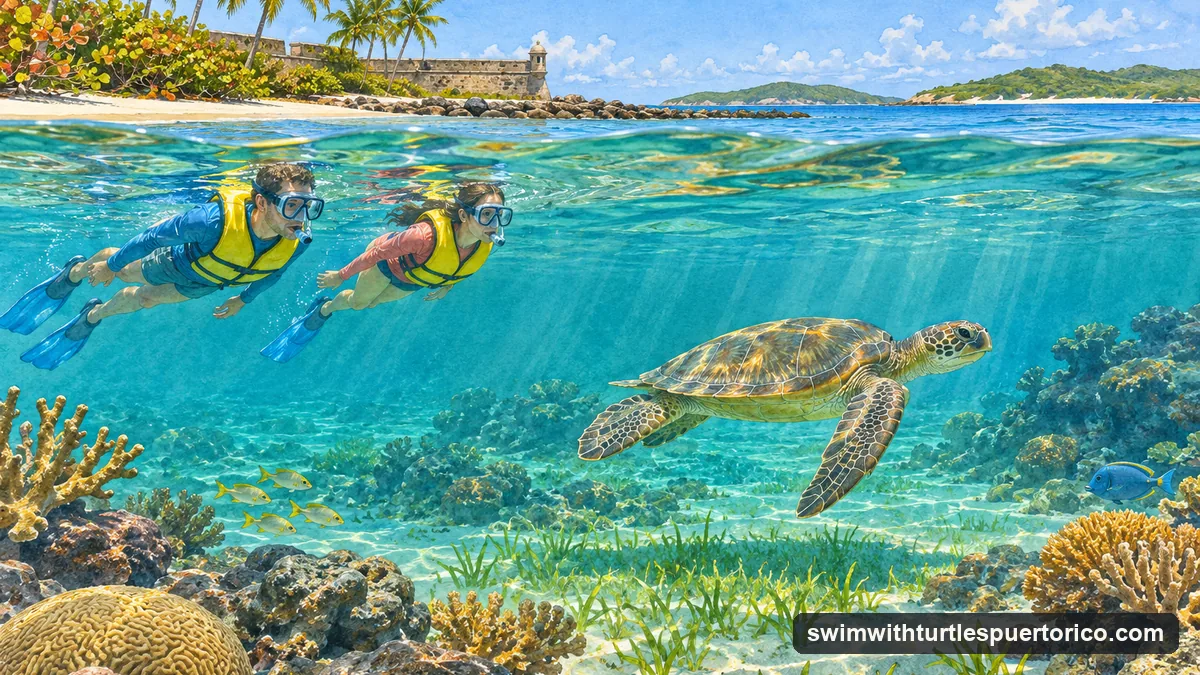
- Coral. Puerto Rico’s coral-reef law (Law 147 of 1999) lets the DRNA fine anyone who damages a coral reef, pollutes it or uses chemicals on it or on the seagrass around it, or anchors outside the mooring buoys in buoyed protected areas: $500 to $10,000 per violation. Float flat, keep your fins up and do not stand on the reef.
- Sunscreen. Puerto Rico has no law against oxybenzone or other sunscreen ingredients: a 2025 bill to ban their sale passed the House, and a Senate committee recommended against it in October 2025. Hawaii, by contrast, has banned the sale of oxybenzone and octinoxate sunscreens since January 2021. “Reef safe” is not a regulated label, so read the ingredients, or cover up with a long-sleeved rash guard.
- Fishing. The Canal Luis Peña reserve off Culebra is closed to fishing, permanently.
Can you snorkel with turtles without a tour?
Yes. Escambrón in San Juan and Tamarindo beach on Culebra are open beaches, and people snorkel there on their own as well as with tours. The rules above apply either way. On your own you bring your own mask, snorkel and fins, and you have no guide watching the sea or knowing where to look. On the open north coast in winter, from November to April, long-period swells and rip currents make that a poor bet; go with a guide or wait for a calm day.
A guided snorkel, if you would rather
Beginner Turtle Snorkel at Escambrón with Videos
Try Scuba Diving's beginner snorkel at Escambrón: a lesson on the sand, an instructor in the water, a free video. From age 8.
Check dates →Small-Group Turtle Snorkel at Escambrón
Sea Adventures of Puerto Rico's VIP snorkel at Escambrón, up to 8 people with a certified guide and a life jacket. Swimmers aged 14 and up.
See the small group →Culebra by Ferry: Turtle Snorkel at Tamarindo and Flamenco Beach
Kayaking Puerto Rico's day by the public ferry, with about two hours of guided shore snorkeling at Tamarindo beach.
See the Culebra day →Prices, ratings and review counts from the listings (GetYourGuide checked October 2026; Viator checked October 2026). Operators price by date and season, so treat the figures as the shape of the market, not a quote.
Where the turtle snorkels are
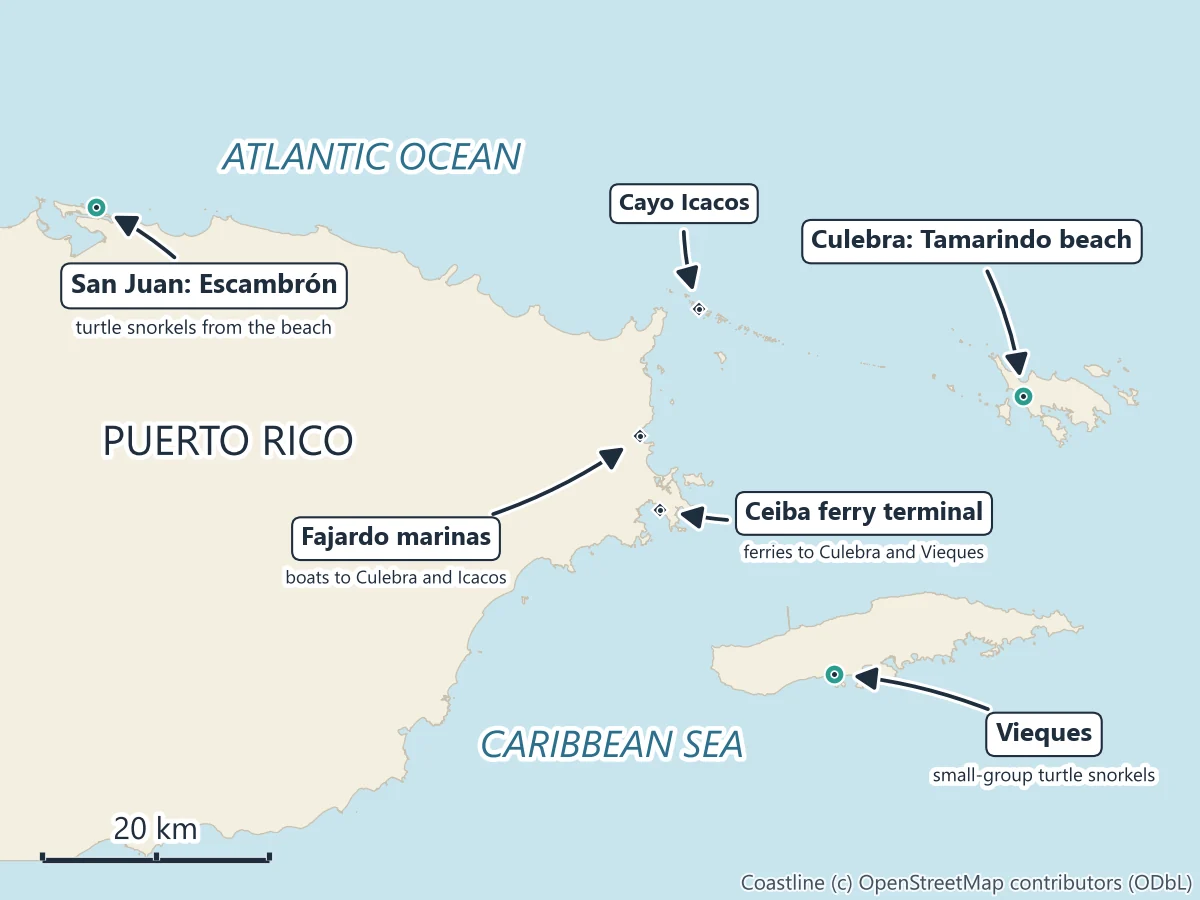
The same rules hold at every one of them. For the beaches and the tours, see San Juan, Culebra and Vieques.
More Trips with Open Dates
More Puerto Rico Snorkel Trips with Open Dates
Turtle snorkels, boat days and island trips with live availability. Times and cancellation terms are on each listing.
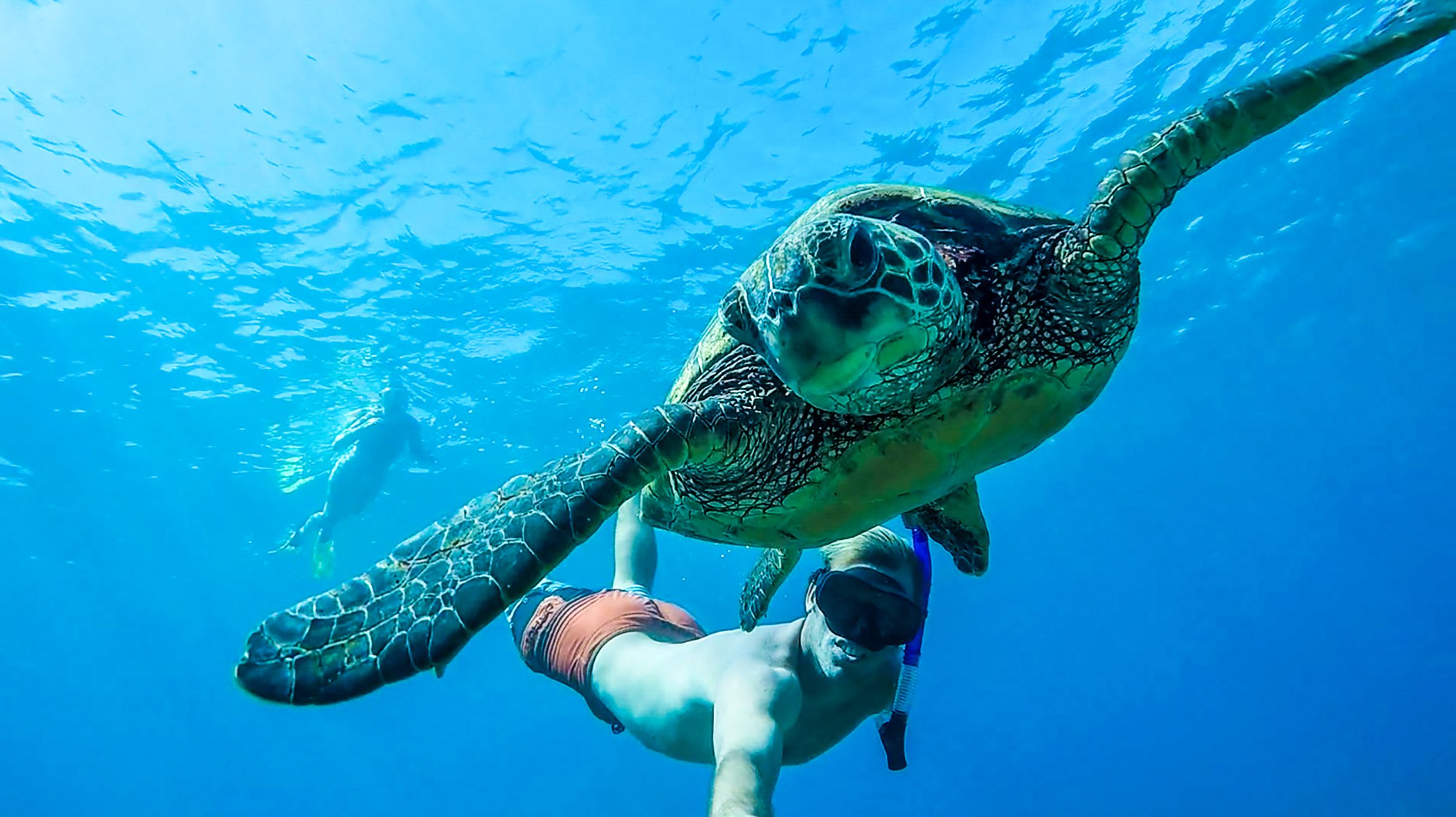
A Guided Turtle Snorkel at Escambrón
Try Scuba Diving's 90-minute beginner snorkel in San Juan: a lesson on the sand, an instructor in the water and a free video.
See dates